Direct answer
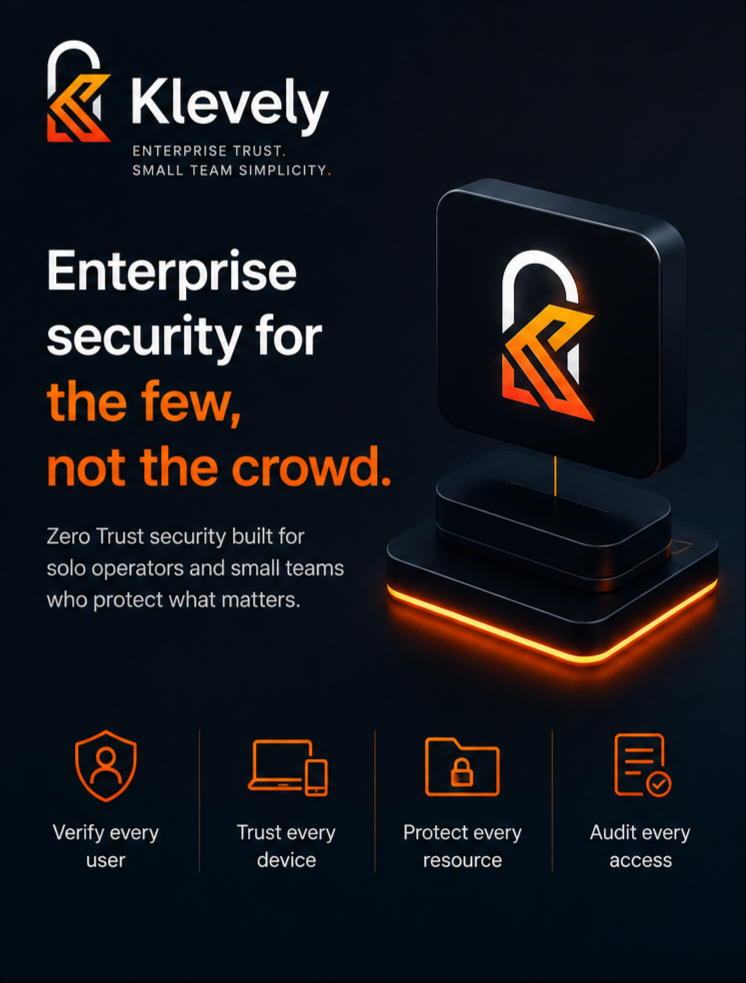
Zero Trust is a security model built on "never trust, always verify." Every user, device, and application must prove itself before access is granted — every time. For solo operators and small teams, Zero Trust is no longer optional: the same sensitive client data once held only by large corporations now sits on freelancers' laptops, with none of the enterprise security infrastructure to protect it.
For years, cybersecurity vendors sold a simple story: "Security is an enterprise problem." If you were a solo consultant, accountant, real estate agent, lawyer, IT contractor, bookkeeper, agency owner, or small business operator, security was often reduced to:
- Use a password manager.
- Turn on MFA.
- Install antivirus.
- Hope for the best.
That world no longer exists.
Today, a one-person business may hold: client financial records, tax information, property contracts, medical information, identity documents, banking details, commercial agreements, and intellectual property. In many cases, a solo operator is now responsible for the same sensitive information as a company with 500 employees. The difference? The large company has a security team. You don't.
The Problem With Traditional Security
Most small businesses build security organically. A typical setup looks like this: Google Drive, Dropbox, email attachments, shared passwords, team chat, random cloud apps, contractors accessing systems from unknown devices.
Over time, data becomes scattered across dozens of locations. The result:
- No visibility. Nobody knows exactly where sensitive data lives.
- No control. Once a file is shared, it may be copied indefinitely.
- No auditing. You often cannot answer: "Who accessed this document?"
- No containment. One compromised device can expose everything.
Why the Old Security Model Fails
Traditional security assumes: "If you're inside the network, you're trusted." That assumption made sense when everybody worked in one office behind one firewall.
Today, people work remotely. Contractors come and go. Devices change constantly. Data lives in the cloud. AI tools access information. Business systems connect to dozens of third-party platforms. The perimeter has disappeared. Trusting everything inside the fence no longer works.
The perimeter has disappeared. Trusting everything inside the fence no longer works.
What Is Zero Trust?
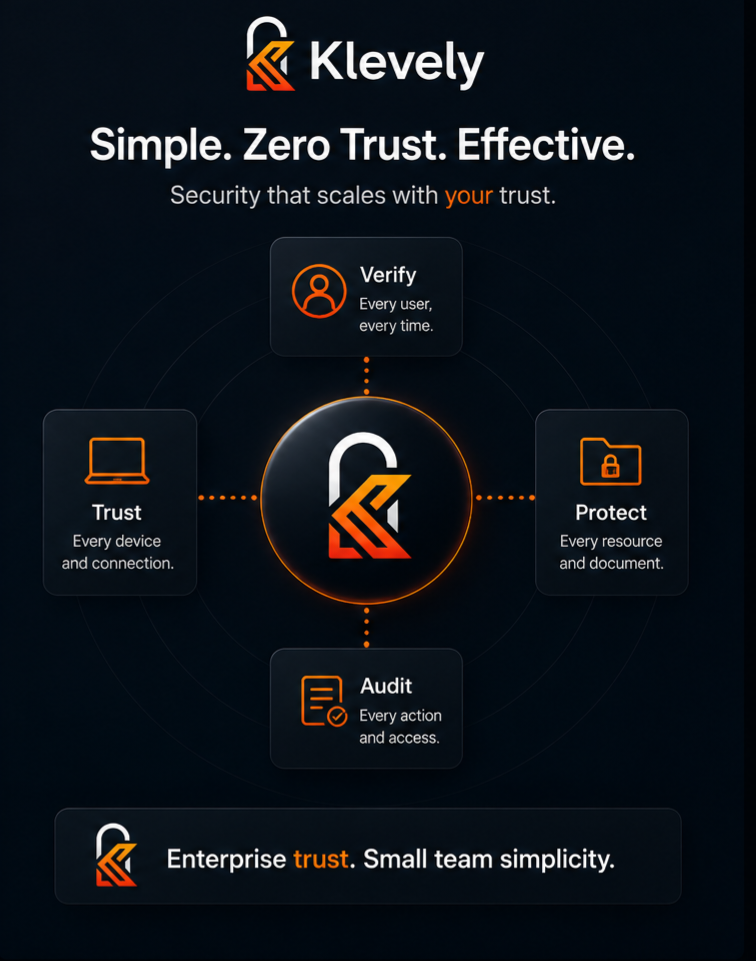
Zero Trust operates on a very simple principle: Never trust. Always verify.
Instead of assuming access should be granted, Zero Trust assumes every request must prove itself. Every user. Every device. Every application. Every time. Access is granted only when required and only to the resources needed. Nothing more.
Why Small Businesses Benefit More Than Enterprises
This surprises many people. Large enterprises can survive a security incident. Most small businesses cannot. A major breach can mean:
- Lost clients.
- Legal exposure.
- Regulatory penalties.
- Reputation damage.
- Weeks of downtime.
For a solo operator, one incident can become an existential threat. That's why Zero Trust is often more valuable to smaller organisations. The goal isn't military-grade security. The goal is reducing the blast radius when something inevitably goes wrong.
The Challenge: Enterprise Tools Weren't Built for Small Teams
Here's where most security vendors get it wrong. They assume every customer has dedicated IT staff, security specialists, large budgets, and hundreds of users. Many platforms impose minimum seat requirements, complex deployment processes, expensive enterprise licensing, and steep learning curves.
A solo consultant with one laptop doesn't need a six-month security project. They need protection that works immediately.
The Missing Middle
There has been a gap in the market for years — between Consumer Security (simple but limited) and Enterprise Security (powerful but complex). Small teams have been forced to choose between not enough security or too much complexity. Neither option is acceptable.
A business with one employee can still hold a million dollars' worth of trust.
What Small Teams Actually Need
Most operators don't need a security operations centre. They need:
- Identity-first access — know exactly who is accessing what.
- Secure client data storage — sensitive information protected by default.
- Device verification — trusted devices only.
- Simple access controls — grant access when needed, remove it instantly.
- Auditability — a clear record of access activity.
- Minimal administration — security should support productivity, not consume it.
The Future of Security for Small Business
Cybersecurity is following the same path as accounting, marketing and cloud infrastructure. Capabilities once reserved for enterprises are becoming accessible to everyone. The businesses that adapt early gain greater client trust, reduced operational risk, better compliance outcomes, and stronger professional credibility.
Increasingly, clients are asking not only "Can you do the work?" but also "Can you protect our information?" That question is becoming a competitive advantage.
Final Thoughts
The conversation around cybersecurity has changed. The question is no longer whether a small business needs enterprise-grade security principles — it does. The real question is: how do you deliver Zero Trust without enterprise complexity?
For solo operators and small teams, security must be simple, affordable, practical, and effective. Because the reality is straightforward:
A business with one employee can still hold a million dollars' worth of trust. And trust is often the most valuable asset any business owns.
About Klevely
Klevely was built around that idea — bringing Zero Trust security principles to solo operators and small teams without the complexity, overhead and minimum-seat requirements traditionally associated with enterprise security.
Join the early access list